Is AI-Written Website Content Automatically Considered Spam by Google?
Updated: Sep 14

Is AI-written content spam?
No. AI-written website content is not automatically considered spam by Google.
Google does not say that a page becomes spam simply because an AI tool helped to write it.
The risk depends on why the content was created, how it was produced and whether it provides genuine value to the person reading it.
AI can be used to research a subject, organise ideas, improve wording or help structure an article. The problem begins when automation is used to publish large amounts of weak, repetitive or misleading content primarily to manipulate search visibility.
That distinction matters for small businesses.
You do not need to stop using AI. You do need to stop treating it as a replacement for knowledge, judgement, evidence and proper editorial review. There is also a customer-trust reason not to let AI replace genuine business knowledge. When almost any company can generate confident, professional copy, the words themselves become less convincing as evidence. AI and Customer Trust: AI Can Make Every Business Sound Professional—So Who Do Customers Trust? looks at what customers can verify when polished marketing language is no longer enough.
If your visibility has already declined, do not automatically assume AI content caused it. Our Google rankings drop diagnostic guide explains how to check the evidence before rewriting or removing useful pages.
The quick answer
AI-assisted content can appear in Google Search when it is:
accurate
original
useful
relevant to the website’s audience
properly reviewed
supported by genuine experience or evidence
written to help customers rather than simply attract clicks
AI-assisted content becomes risky when it is:
mass-produced
copied or lightly rewritten
factually unreliable
filled with generic advice
created only to target keywords
presented as expert guidance without real expertise
duplicated across multiple services or locations
disconnected from what the business genuinely offers
Google’s guidance says generative AI can be useful for research and for adding structure to original content. It also warns that using AI to generate many pages without adding value may breach its policy on scaled content abuse.
The issue is not simply whether AI was involved.
The issue is what you published.
What does Google actually say about AI content?
Google’s published guidance focuses on helpful, reliable and people-first content.
It recommends asking who created the content, how it was created and, most importantly, why it was created.
If the purpose is to help an existing or intended audience, the content is moving in the right direction.
If the purpose is mainly to generate search-engine traffic, especially through large-scale automation, the risk is much greater. Google explicitly states that using automation, including AI generation, primarily to manipulate search rankings violates its spam policies.
Google’s spam policy does not define spam as “anything written by a machine”.
It defines spam around attempts to deceive users or manipulate Google’s search systems. Those policies apply to traditional results and attempts to influence generative AI responses within Google Search.
This is why the question “Did AI write this?” is too simplistic.
Better questions are:
Does the page help a genuine customer?
Does it contain original input?
Is it factually correct?
Does it reflect the real business?
Has somebody competent reviewed it?
Was it created because the topic matters to customers?
Would the page still be worth publishing if Google sent it no visitors?
If the answer to several of those questions is no, the content probably needs work regardless of how it was written.
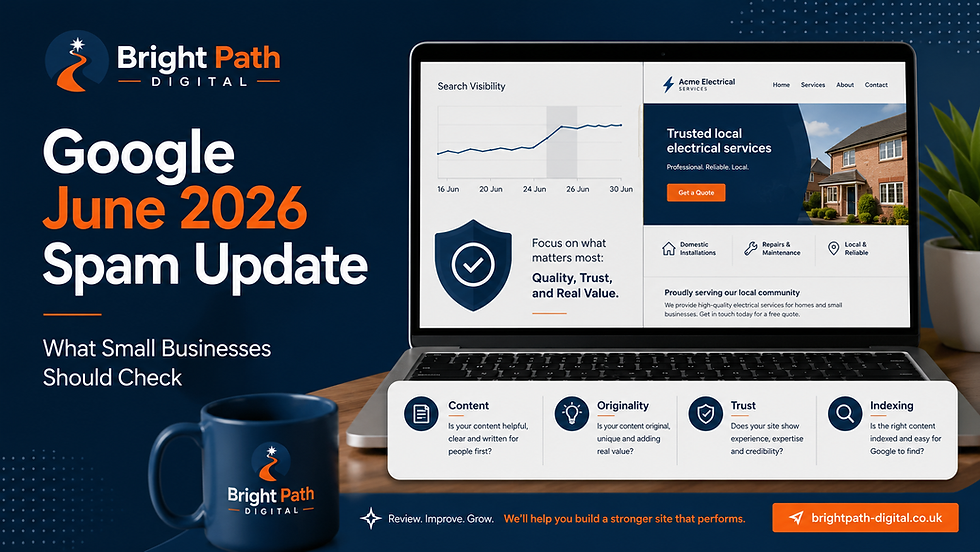
For the wider context, read our guide to Google’s June 2026 spam update.
What Did Google’s August 2026 Spam Update Tell Us About AI Content?
The update began on 18 August and completed on 21 August. It applied globally and across all languages.
Google did not announce a new spam policy alongside the update, and it did not say that AI-generated content was specifically being targeted.
That distinction matters.
Following the update, industry reports suggested that some websites relying heavily on mass-produced, SEO-focused AI content experienced substantial losses in search visibility.
That is useful evidence, but it should not be turned into a claim that Google introduced an “AI content penalty”.
Google has not confirmed that.
What Google has confirmed is its existing policy on scaled content abuse.
The problem is creating large numbers of pages primarily to manipulate search rankings while providing little or no additional value to users. Google specifically includes the use of generative AI to produce many low-value pages as one possible example, but the policy applies regardless of whether the content was created by AI, humans or a combination of both.
For a small business, the practical distinction is therefore:
Using AI to help produce useful content is not the same as using AI to manufacture search traffic at scale.
An AI-assisted article that begins with genuine business knowledge, answers a real customer question, contains accurate information and is properly reviewed is fundamentally different from automatically publishing hundreds of pages simply because keyword research identified hundreds of search terms.
The August update does not overturn Google’s previous guidance.
If anything, the reported effects reinforce the reason to focus on:
genuine customer questions
original knowledge and experience
useful examples
accurate information
proper editorial review
a clear connection with what the business actually does
quality rather than publishing volume
The wrong lesson from the August update would be:
“Stop using AI.”
The more useful lesson is:
Do not use AI as an excuse to publish content that would not deserve to exist without the possibility of Google traffic.
AI-assisted and AI-generated content are not all the same
The phrase “AI-written content” covers several very different ways of working.
A business owner might use AI to:
organise their own rough notes
improve grammar
create a first-draft structure
turn a recorded explanation into an article
identify questions customers may ask
simplify technical wording
suggest alternative headings
summarise their own research
prepare a draft that is then substantially rewritten
That is very different from entering a keyword, accepting the first response and publishing it without checking anything.
It is also different from generating hundreds of service, location or blog pages automatically.
The amount of human involvement matters because human input is usually where the genuinely useful information comes from:
first-hand experience
customer questions
real examples
professional judgement
local knowledge
service limitations
pricing context
evidence
business-specific processes
an honest opinion
AI can help communicate those things.
It cannot invent them without creating a serious risk of false or generic content.
When can AI-written content become spam?
There is no single sentence, word count or percentage of AI involvement that automatically turns a page into spam.
The risk normally comes from the wider publishing approach.
1. Publishing content at scale without adding value
The clearest danger is using AI to create large numbers of pages quickly while adding little useful information.
Examples include:
publishing several vague blog posts every day
generating a separate article for every minor keyword variation
producing dozens of almost identical location pages
creating hundreds of question-and-answer pages
automatically rewriting competitor content
building pages for services the business barely provides
publishing content across subjects in which the business has no real knowledge
Google’s scaled-content policy is not limited to AI. It covers content produced at scale primarily to manipulate rankings, regardless of whether it was created by people, automation or a combination of both.
The brutal truth is that a faster content-production process does not create a stronger website. It only creates weak content faster when the strategy is poor.
The August 2026 spam update makes this distinction particularly timely.
Some industry observers reported significant visibility losses among websites using highly automated AI publishing models. Google did not confirm that AI-generated content itself was the target, so those reports should not be treated as proof of an AI-specific penalty.
They are, however, another reason to be cautious about a strategy built around producing large volumes of pages primarily because they can be generated cheaply and quickly.
If automation has allowed a website to increase from 20 genuinely useful pages to 2,000 superficial ones, the ability to produce those extra pages is not necessarily an advantage.
Scale only helps when the additional content also deserves to exist.
2. Rewriting information that already exists elsewhere
AI tools are good at producing plausible summaries of common online information.
That does not mean the result deserves another page on the internet.
A new article should contribute something useful beyond what competing pages already say.
That could be:
a clearer explanation for a specific audience
a practical checklist
a local-business perspective
examples from real work
an original comparison
a decision-making framework
common mistakes you have personally encountered
a more honest explanation of limitations or costs
Google’s content-quality guidance asks whether a page provides original information, substantial value and insight beyond the obvious. It also warns against simply summarising other sources without adding much value.
Changing the wording is not the same as adding value.
3. Publishing factual errors
AI output can sound confident even when the information is wrong.
Typical problems include:
invented statistics
outdated legal or regulatory information
incorrect product specifications
false quotations
non-existent research
fabricated locations
inaccurate prices
services the business does not offer
instructions that are unsafe or unsuitable
American advice presented to a UK audience
Google recommends focusing on accuracy, quality and relevance when content is automatically generated. That applies not only to the main copy but also to titles, meta descriptions, structured data and image alt text.
One invented fact can damage customer trust more than an entire article can build it.
4. Pretending to have experience you do not have
AI can easily produce wording such as:
From our years of experience...
Our clients regularly tell us...
We have found that...
Those statements should not be published unless they are true.
Do not allow an AI tool to invent:
clients
projects
qualifications
tests
case studies
customer feedback
performance results
professional experience
local knowledge
Cheap AI content has also helped create a wider market for supposed AI-search shortcuts. Our guide to AI SEO myths for small businesses looks at which new tactics deserve attention and which ones should not automatically justify another SEO bill.
False experience is not a clever SEO shortcut. It is misleading marketing.
Your content should show genuine knowledge without claiming evidence that does not exist.
5. Creating near-identical location pages
A common misuse of AI is asking it to create separate pages for every town in a service area.
The resulting pages often contain the same structure, claims and advice with only the location name changed.
For example:
Website design in Liverpool
Website design in Wirral
Website design in St Helens
Website design in Sefton
Website design in Knowsley
Separate pages may be justified when each one provides genuinely distinct and useful information.
They become weak when the only meaningful difference is the place name.
Changing a town name is not local expertise.
If location pages are part of your SEO plan, our guide to whether you should create a website page for every town you serve explains what genuine local differentiation can look like before you generate additional URLs.
A legitimate location page may include:
services genuinely offered in that area
relevant customer examples
realistic coverage information
local photographs
area-specific questions
travel or appointment information
testimonials from nearby customers
genuine knowledge of the local market
Do not use AI to manufacture local relevance that the business does not possess.
6. Producing content that does not match the business
A roofing company does not need articles about every topic connected to property ownership.
A web designer does not need to publish daily general technology news.
A bookkeeper does not need hundreds of vague business-motivation articles.
Content should support:
the services the business actually provides
questions genuine customers ask
decisions customers need to make
concerns that prevent enquiries
topics the business can discuss credibly
Google advises website owners to maintain a clear purpose or focus rather than publishing across many unrelated subjects in the hope that some of them attract traffic.
More topics do not automatically mean more authority.
Often they mean a less focused website.
Can a small business use AI safely for website content?
Yes, but the process needs to be controlled.
A sensible approach is to use AI as an assistant rather than an unsupervised publisher.
Safe AI use is also about what you give the tool in the first place. Before pasting customer information, internal documents, contracts, financial details or other business material into a prompt, read What Business Information Should You Never Put Into AI Tools? for a practical guide to what should be protected, minimised or redacted.
Good uses of AI
AI can help you:
turn rough notes into a clearer structure
suggest questions the article should answer
simplify complicated wording
identify repetitive sections
generate alternative headings
check whether the explanation is easy to follow
turn a spoken explanation into a first draft
prepare a checklist from information you supply
improve spelling and grammar
adapt your own knowledge into different formats
Poor uses of AI
Do not rely on AI to:
decide what your business has experienced
invent examples
produce final technical, medical, financial or legal advice
create customer testimonials
make claims about your results
generate dozens of pages without review
copy competitors
impersonate a named expert
decide whether information is definitely current
replace your understanding of the customer
The best content process usually begins with human knowledge and uses AI to help organise or communicate it.
The weakest process begins with a keyword and asks AI to fill an empty page.
A practical AI-content review before publishing
Use the following checks before adding any substantially AI-assisted content to your website.
1. Confirm the page has a genuine purpose
Write one sentence explaining why the page needs to exist.
A strong purpose might be:
This article will help local business owners decide whether AI-assisted website content needs to be rewritten.
A weak purpose might be:
This page will target the keyword “AI website content”.
The first starts with the customer.
The second starts with the ranking opportunity.
2. Identify the intended reader
Be specific.
Is the content for:
a sole trader launching a first website?
an established local business reviewing old blog posts?
a tradesperson considering location pages?
a professional service firm handling sensitive advice?
an ecommerce business creating product descriptions?
Generic content usually comes from writing for “everyone”.
3. Check every factual statement
Verify:
dates
statistics
prices
technical claims
regulations
product details
quotations
company information
locations
external links
Do not assume a claim is correct because it sounds professional.
Where accuracy matters, use a reliable primary source.
4. Add something the AI could not know
Include at least one or two pieces of genuine business input, such as:
a common customer question
an example from your work
a practical limitation
a mistake you regularly see
your actual process
a clear professional opinion
relevant local context
realistic pricing considerations
This is where a generic draft begins to become useful content.
5. Remove filler
Delete sentences that:
repeat the heading
restate the previous paragraph
use vague phrases such as “in today’s digital world”
make obvious claims without explaining them
add length but no meaning
sound impressive but provide no practical information
Do not publish 1,500 words when 800 useful words would answer the question properly.
Google does not have a preferred article word count. Its guidance explicitly warns against writing to a particular length simply because somebody claims Google prefers it.
6. Check for duplication
Compare the draft with:
existing service pages
previous blog posts
location pages
FAQs
competitor articles used during research
Ask whether the new page has a distinct purpose.
Several pages covering the same subject can compete with or dilute each other.
Sometimes the correct decision is to improve an existing article rather than publish another one.
Our guide to what pages a small-business website needs explains why page quality matters more than page quantity. BrightPath’s live guidance makes the same point directly: a focused seven-page website can outperform a much larger site filled with duplicated or superficial information.
7. Check that the content sounds like your business
Look for:
American spelling or terminology
language that is too corporate
exaggerated promises
services you do not provide
an unnatural tone
phrases you would never say to a customer
unexplained jargon
inconsistent pricing or processes
Read the article aloud.
If it sounds nothing like the business, it is not ready.
8. Strengthen trust
Make it clear:
who wrote or reviewed the page
which business published it
why the information can be trusted
when it was last checked
where factual claims came from
how a customer can ask a question
Google encourages clear authorship information where readers would reasonably expect it. It also suggests explaining how content was produced when substantial automation was involved and that information would be useful to readers.
For more practical trust improvements, read How Clear Messaging and Trust Signals Boost a Small Business Website.
9. Review the SEO settings separately
AI-generated titles and descriptions can also be inaccurate, repetitive or over-optimised.
Check the:
URL
title tag
meta description
H1
heading structure
image alt text
internal links
indexing status
structured data, where used
Each field should accurately describe the page.
Do not insert keywords into every available box.
Our SEO settings guide for small businesses explains the main Wix fields to review.
BrightPath’s guidance notes that these settings are important foundations, but do not guarantee rankings by themselves.
10. Give the reader a useful next step
A blog article should not finish without helping the reader decide what to do next.
The next step might be:
check an existing page
read a related guide
compare two options
contact the business
request an audit
review Search Console
download a checklist
update inaccurate information
The call to action should follow naturally from the article.
It should not feel like an unrelated sales pitch added to the final paragraph.
Should you disclose that AI helped create the content?
Google does not state that every AI-assisted sentence needs a warning label.
Its guidance says information about how content was produced can help readers, particularly where someone would reasonably wonder how it was created. It recommends considering context or disclosures when automation substantially generated the content.
Use judgement.
A disclosure may be useful when:
AI generated a substantial portion of the content
the article contains automated analysis
AI-created images are presented as factual evidence
the method of production could affect trust
readers would reasonably expect transparency
A disclosure does not rescue weak content.
Writing “created with AI” underneath an inaccurate, generic article does not make it helpful.
Likewise, hiding AI involvement does not turn weak content into strong content.
The priority remains accuracy, usefulness, originality and honest review.
Does editing AI content make it safe?
Not automatically.
Changing a few words or correcting the spelling is not a meaningful review.
A proper edit should examine:
factual accuracy
customer relevance
originality
tone
evidence
claims
structure
duplication
commercial purpose
the next step for the reader
The question is not whether a human touched the draft.
The question is whether meaningful human judgement improved it.
Can Google tell whether content was written by AI?
The more useful question is whether Google can identify the characteristics of weak or manipulative content.
Google’s policies and quality guidance focus on outcomes such as mass production, low originality, little added value and content created primarily to influence rankings.
Trying to make AI text “undetectable” misses the point.
Even when a page is not identified as AI-generated, it can still perform badly because it is generic, inaccurate, unhelpful or untrusted.
Do not spend your effort trying to disguise the production method.
Spend it making the content worth reading.
Should you delete existing AI-written pages?
Do not delete everything simply because AI was involved.
Review the pages individually.
Keep the page when it is:
useful
accurate
distinctive
relevant to the business
attracting suitable visitors
supporting customer decisions
linked to an appropriate service
generating enquiries or useful engagement
Improve the page when it is:
relevant but generic
missing real examples
poorly structured
weakly sourced
repetitive
outdated
unclear about the next step
Merge the page when it:
duplicates another article
targets a minor variation of the same question
is too thin to justify a separate URL
splits useful information across several weak pages
Remove or redirect the page when it:
serves no genuine purpose
contains false information
targets a service the business no longer provides
was created only to capture a keyword
has no useful content worth preserving
is part of a group of near-identical pages
Do not make decisions based on page views alone.
A low-traffic page can still answer an important customer question. A high-traffic page can still attract entirely the wrong audience.
Use Search Console to review impressions, clicks, search queries and affected pages before making wider changes. Our Google Search Console monthly checklist explains the reports small businesses should monitor.
A ten-minute AI-content check
Choose one AI-assisted page and ask:
Why does this page exist?
Who is it intended to help?
Is every important claim accurate?
Does it contain genuine business knowledge?
Is it substantially different from our other pages?
Does it add more than a summary of other websites?
Does it sound like our business?
Are any examples, statistics or experiences invented?
Is the author or reviewer clear?
Does the page lead towards a useful next step?
If several answers are weak, do not publish the page yet.
That does not prove the page is spam.
It does prove that the content is not ready.
Frequently asked questions
Is all AI-generated website content against Google’s rules?
No. Google does not prohibit content simply because generative AI was involved. It warns against using automation to create large amounts of content without adding value or primarily to manipulate rankings.
Can AI content rank on Google?
AI-assisted content can appear in Google Search when the page is relevant, useful, accurate and compliant with Google’s wider policies. The use of AI does not guarantee rankings, and neither does human authorship.
How much AI content is too much?
Google does not publish an acceptable percentage or word limit. Review the purpose, quality and scale of the content rather than trying to calculate how many AI-written sentences are allowed.
Does human editing prevent AI content from being spam?
No. Superficial editing does not fix content created primarily to manipulate rankings. Human review is useful only when it adds accuracy, judgement, originality and genuine value.
Should every AI-assisted article include a disclosure?
Not necessarily. Google suggests that disclosures or production context can be useful where automation was substantial or where readers would reasonably expect to know how the content was created.
Is using AI for meta descriptions acceptable?
Yes, but the result still needs to be accurate, relevant and specific to the page. Automatically generating repetitive or misleading metadata creates the same quality problem as weak main-page copy.
Final thoughts
AI is a tool.
It can help a small business communicate more clearly, organise knowledge and create useful first drafts.
It can also make it dangerously easy to publish large amounts of generic content that nobody needed.
The difference is not the software.
The difference is the judgement applied before publication.
Use AI to support genuine knowledge, not manufacture it.
Use it to make useful information clearer, not to create pages simply because another keyword exists.
And never publish something you would not be comfortable explaining, defending or showing directly to a customer.
Unsure whether your website content is helping or hurting?
Weak content does not always look obviously bad.
It may be grammatically correct, professionally formatted and still fail to explain what makes the business credible, relevant or worth contacting.
BrightPath Digital’s Copy, Trust & Credibility Audit reviews your publicly accessible website from a customer and search-foundation perspective. For wider site structure and local-search concerns, explore the SEO and Local Visibility Audit.
Depending on the audit selected, we can examine areas including:
website copy
content quality
headings and page structure
trust and credibility
internal links
local wording
SEO foundations
calls to action
content gaps
customer journey
You receive plain-English findings and a prioritised improvement plan showing what needs attention first.


Comments