Google’s June 2026 Spam Update: What Small Businesses Should Check Now
- BrightPath Digital Editorial Team
- Jun 27
- 10 min read
Updated: 6 hours ago
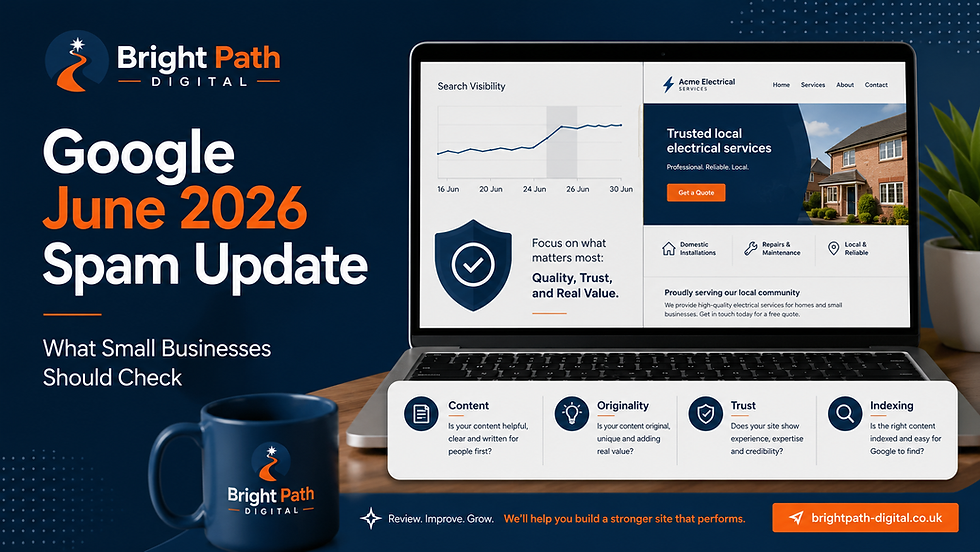
Google June 2026 spam update
Google completed its June 2026 spam update after a short rollout between 24 and 26 June.
The update applied globally and across all languages. It was an update to Google’s automated spam-detection systems, not a broad core update and not the launch of a completely new set of SEO rules.
For most genuine small businesses, this is not a reason to panic, remove every blog post or stop using AI tools.
It is a reason to look honestly at whether your website contains pages that are repetitive, unoriginal, misleading or created mainly to attract search traffic rather than help potential customers.
Quick answer: what changed in June 2026?
Google regularly improves the automated systems it uses to detect websites and pages that break its spam policies.
These systems include SpamBrain, Google’s AI-based spam-prevention system. Google describes spam updates as improvements to the way these systems identify existing and emerging forms of search manipulation.
The June 2026 rollout:
began on 24 June 2026
completed on 26 June 2026
applied globally
applied to all languages
did not introduce a newly announced collection of spam policies
did not come with a confirmed list of specific website types or industries being targeted
That last point matters.
Nobody outside Google can honestly provide a complete list of exactly what the update detected. Any article claiming that the update definitely targeted one particular kind of content is going beyond what Google publicly confirmed.
Was the June update targeting AI-generated content?
Not specifically, as far as Google has publicly confirmed. For a fuller explanation, read Is AI-Written Website Content Automatically Considered Spam by Google?
Google has not said that the June update was an “AI content penalty”.
Using AI to research, organise ideas, improve wording or assist with a first draft is not automatically a spam violation.
The problem is scaled content abuse: producing large numbers of pages mainly to manipulate rankings while adding little original value for the person reading them.
Google’s examples include using generative AI to create many pages without adding useful value, combining material from different websites without meaningful input, scraping other content and producing pages that contain search keywords but make little sense to a real reader.
The production method is not the main issue.
The real questions are:
Is the page useful?
Is it accurate?
Has someone with relevant knowledge reviewed it?
Does it provide anything original?
Does it answer a real customer question?
Would the page still deserve to exist if Google sent it no traffic?
If the honest answer to the final question is no, the page probably needs attention.
Google’s spam policies now include AI search manipulation
There is a separate but related change worth understanding.
Google updated its spam-policy wording in May 2026 to make clear that attempts to manipulate generative AI responses in Google Search can also be treated as spam.
That includes attempts to manipulate visibility within features such as AI Overviews or other generative Search experiences, not only attempts to improve traditional organic rankings.
This does not mean businesses should ignore AI search visibility.
It means there is no separate set of acceptable shortcuts for getting mentioned by an AI-generated answer.
Manufactured recommendations, misleading “best company” lists, fake authority signals and content created mainly to influence an AI system can fall under the same spam framework as other manipulative SEO practices.
Google has not confirmed that the June update specifically targeted AI-answer manipulation. The connection should therefore be treated as an important policy direction, not a confirmed explanation for every ranking movement in late June.
What types of small-business website content should be reviewed?
Most genuine local businesses are not operating sophisticated spam networks.
However, small-business websites can still accumulate weak pages through poor SEO advice, rushed content production, duplicated templates or years of neglected website changes.
The following areas deserve attention.
Near-identical location pages
Location pages are not automatically spam.
A plumber genuinely serving Liverpool, Wirral and St Helens may have a legitimate reason to create useful pages explaining the services available in each area.
The risk appears when dozens of pages are almost identical, with only the town name replaced.
For example:
We provide professional plumbing services in Liverpool.
We provide professional plumbing services in Wirral.
We provide professional plumbing services in St Helens.
If the services, examples, evidence, photographs, FAQs and customer information are otherwise identical, those pages add very little.
Google’s doorway-abuse policy specifically includes substantially similar regional or city pages created mainly to capture related searches and funnel visitors towards the same destination.
A worthwhile location page should contain genuine local relevance, such as:
services commonly requested in that area
real projects or customer examples
realistic coverage information
location-specific FAQs
photographs from work completed nearby
relevant travel, access or appointment information
testimonials from customers in the area
Changing a place name is not localisation.
Large numbers of shallow blog posts
Publishing more articles does not automatically produce better SEO.
A website containing 100 vague, repetitive articles may be weaker than a website containing 20 focused, genuinely useful guides.
Review posts that:
repeat information already covered elsewhere
provide only obvious advice
contain no examples or practical detail
were created primarily to target minor keyword variations
make claims without evidence
do not reflect the services or experience of the business
have received no impressions, clicks, engagement or internal links
sound interchangeable with articles on hundreds of other websites
Do not keep weak content simply because somebody told you that Google rewards “fresh content”.
Google rewards neither a publishing schedule nor a word count by itself.
AI-assisted content published without proper review
AI can help a small business produce clearer content, but unedited output creates obvious risks.
Common problems include:
invented facts
generic recommendations
repeated conclusions
false local references
services the business does not actually provide
American terminology on a UK website
fake statistics
unsupported claims
excessive headings and lists
articles that sound polished but say very little
Every important article should be reviewed by a person who understands the business and the subject.
Add the information AI cannot genuinely know without your input: your experience, process, limitations, examples, opinions, pricing context and understanding of customer concerns.
Copied or lightly rewritten material
Taking an article from another website, replacing a few words and publishing it is not original content.
Neither is combining sections from several competing articles and smoothing the result with an AI tool.
Google’s scraping policy covers copied material, lightly modified content and collections of information that provide no substantial additional benefit to the reader.
Research is normal.
Replication is not.
Use external sources to understand a subject, then build something more useful around your own audience, expertise and commercial purpose.
Keyword and location stuffing
Repeating a service or town name unnaturally does not make a page more relevant.
It makes the content harder to read and can cross into keyword stuffing.
Google specifically lists blocks of town or regional names and unnatural repetition among its keyword-stuffing examples.
A page should make the service area clear, but it should sound like it was written for a customer rather than a ranking system.
For practical guidance on titles, descriptions, URLs, headings and indexing, read our guide to SEO settings for small businesses.
Old, hacked or forgotten pages
Spam is not always intentionally added by the business owner.
An insecure website can be compromised, allowing somebody else to inject pages, links, redirects or hidden content.
Check for:
pages you do not recognise
unexpected languages in Google’s index
gambling, pharmaceutical or adult-content URLs
unusual redirects
sudden increases in indexed pages
hidden links
security warnings
unfamiliar users in your website account
plugins, apps or integrations that are no longer maintained
Google’s policies recognise page injection, content injection, hidden links and malicious redirects as common forms of hacked spam.
What did Google not confirm?
Google did not publicly announce:
the percentage of searches affected
a list of industries affected
a specific focus on AI-written pages
a specific word-count threshold
a new quality score
a universal recovery process
a guaranteed recovery timeframe
Search Engine Roundtable reported that Google said this particular update did not focus on link spam or the site reputation abuse policy. That does not mean those practices are now acceptable. They remain within Google’s wider spam policies and may be addressed by other systems or future updates.
Do not let speculation distract you from reviewing your own evidence.
How to check whether your website was affected
A traffic drop after 24 June does not automatically prove that the spam update caused it.
Traffic can change because of seasonality, competitor improvements, tracking problems, technical errors, demand changes, core updates, AI-generated search results or normal ranking volatility.
Start with evidence.
1. Record the rollout dates
Mark 24 to 26 June 2026 in your reporting.
Look for changes that begin during or shortly after that period rather than attributing every poor week in June to the update.
2. Check Google Search Console
Compare performance before and after the rollout.
Review:
total clicks
total impressions
average position
individual pages
individual search queries
branded and non-branded searches
mobile and desktop performance
countries and locations
indexing reports
manual actions
security issues
Our Google Search Console monthly checklist explains the main areas a small business should monitor.
A drop in impressions usually means the website is appearing less often.
Stable impressions with fewer clicks may point towards weaker click-through rates, changing search layouts or more searches being answered directly on Google.
A ranking loss limited to one group of pages suggests a more focused content or relevance problem than a site-wide fall.
3. Rule out technical problems
Before rewriting your content, check whether important pages are still:
live
indexable
included in your sitemap
linked from the website
using the correct canonical URL
loading properly
accessible on mobile
free from accidental redirects
free from noindex settings
Our guide to why a business may not be showing up on Google covers the most common visibility checks.
4. Review the pages that lost visibility
Do not begin by rewriting the entire website.
Identify the pages that actually declined and assess them individually.
Ask:
What search need was this page meant to meet?
Does it answer that need better than competing pages?
Is the information original and specific?
Is any section included only for SEO?
Does the page repeat another page on the website?
Are its claims supported?
Is it still accurate?
Does it naturally connect to a relevant service or next step?
If several pages serve the same purpose, combining them into one stronger resource may be more useful than keeping multiple weak versions.
5. Review the wider site
Google’s automated systems do not assess only your newest article.
Look for forgotten content such as:
old service pages
duplicate location pages
test pages
expired offers
thin category pages
copied supplier descriptions
outdated blog posts
unused landing pages
old campaign URLs
automatically generated tag pages
A website can have strong new content while still carrying years of low-value pages.
What should you improve?
The correct response is not to “optimise harder”.
It is to remove the gap between what the page promises and what it genuinely delivers.
Give every page a clear purpose
One important page should have one clear job.
A service page should explain the service.
A location page should provide genuine local information.
A blog post should answer a real question.
A contact page should make the next step easy.
Trying to make every page rank for every service and every town usually creates confused, repetitive content.
Add information only your business can provide
Useful originality can come from:
genuine experience
examples
photographs
customer questions
mistakes you regularly see
realistic pricing context
limitations
local knowledge
your working process
clear professional opinions
You do not need to reveal confidential customer information.
You do need to contribute something beyond a rewritten summary of existing search results.
Strengthen credibility
Useful content should make it clear why the reader can rely on it.
Show:
who wrote or reviewed the content
the business behind the website
relevant experience
genuine examples
accurate contact details
customer reviews
service limitations
when the page was last reviewed
sources for factual or technical claims
Our guide to clear messaging and website trust signals explains how clarity and evidence work together.
Improve the website as a connected system
Content quality is not isolated from the rest of the customer journey.
A useful article should link towards relevant service information. Service pages should answer the questions created by the article. Calls to action should match the visitor’s level of readiness.
Our guide to optimising and managing a small-business website for growth explains how visibility, trust, conversion and ongoing improvement connect.
What should you avoid doing?
After a ranking drop, avoid making the situation worse through rushed decisions.
Do not:
delete every AI-assisted article
publish dozens of new posts to replace lost traffic
buy backlinks as a quick fix
create more location pages
change every URL
rewrite content that is still performing well
blame the update without checking Search Console
pay anybody who guarantees a rapid recovery
assume changing title tags alone will solve a content-quality problem
Google says that improvements after a spam-related change may take months to be reassessed by its automated systems. A genuine fix does not guarantee an immediate return to the previous position.
A ten-minute spam-risk self-check
Choose five important pages and ask:
Does each page have a distinct purpose?
Would a real customer find the page useful?
Does it provide information that is specific to our business or audience?
Is any wording repeated unnaturally for SEO?
Are our location pages genuinely different?
Has AI-assisted content been checked for accuracy and originality?
Are claims supported by evidence?
Are there old or forgotten pages still indexed?
Does each page link naturally to a relevant next step?
Would we be comfortable showing the page to a customer face to face?
Several weak answers do not prove that Google has penalised the website.
They do show that the site has visible weaknesses worth correcting.
Final thoughts
Google’s June 2026 spam update was not a declaration that SEO, blogging or AI tools are finished.
It was another improvement to the systems Google uses to identify content and tactics designed primarily to manipulate search visibility.
For small businesses, the safest direction is also the most commercially sensible one:
Create pages that help customers understand what you offer, show genuine evidence, answer useful questions and make the next step clear.
Do not create content simply to fill a publishing calendar or target another keyword variation.
A smaller website with clear, useful and credible pages is more valuable than a larger website full of repetition.
Concerned about the visible quality of your website?
A public-facing review cannot prove that a Google update caused a traffic drop. A proper traffic-loss investigation normally requires access to Search Console, analytics and historical performance data.
However, it can identify visible weaknesses such as thin pages, unclear service content, repetitive location wording, poor internal links, weak trust signals and confusing customer journeys.
BrightPath Digital’s Website Audit and Improve service provides a clear, plain-English review of the pages potential customers and search engines can see.
You receive practical recommendations showing what may be holding the website back and which improvements should be prioritised first.
Request your public-facing SEO and Local Visibility Audit.


Comments