Google May 2026 Core Update: What Changed and What Small Businesses Should Review
Updated: Aug 21
Google May 2026 core update
Google’s May 2026 core update caused significant movement across search results, leaving some websites with stronger visibility and others with noticeable declines.
The update began on 21 May 2026 and completed on 2 June 2026. Google described it as a regular core update intended to surface more relevant and satisfying content from all types of websites.
For small businesses, the sensible response is not to panic, rewrite every page or assume the website has been penalised.
The right response is to identify what actually changed, review the pages and searches affected, and decide whether competing websites are now providing a clearer, more useful or more trustworthy answer.
The quick answer
The May 2026 core update did not introduce one simple new ranking rule.
Google’s core updates make broad changes to how its systems assess and rank content. They do not normally target one industry, one website platform or one type of page.
The May update appears to have been more volatile than the March 2026 core update.
Industry analysis found substantial gains and losses across different countries and sectors, with particularly strong movement in sensitive areas such as health and finance. There were also examples involving scaled, repetitive and lower-quality content, although these observations should not be treated as a complete list of what Google changed.
The central lesson for a small business is straightforward:
A page can lose visibility without being technically broken or formally penalised. Another page may now be judged as a better result.
What is a Google core update?
A core update is a broad change to the systems Google uses to assess search results.
Google explains that these updates are designed to improve the overall relevance and reliability of the results shown to searchers. They do not normally single out one website or webpage for punishment.
Think of it as Google reassessing its overall shortlist.
Your page may not have become worse overnight. However, Google may now have greater confidence in another page because it provides:
a clearer answer
more original information
stronger evidence
better first-hand experience
a more trustworthy source
a more satisfying customer experience
a closer match to the searcher’s intent
That distinction matters because the correct response is usually improvement, not panic.
The May core update was not the June spam update
The May 2026 core update and the June 2026 spam update were separate events.
A core update broadly reassesses which results appear most useful and relevant.
A spam update focuses more specifically on practices that violate Google’s spam policies, such as manipulative, deceptive or scaled publishing approaches.
A website losing visibility during a core update does not automatically mean it has been accused of spam.
However, weak publishing practices can still leave a website vulnerable during either type of update. These may include large amounts of generic content, near-identical location pages, copied information, unsubstantiated claims or pages created primarily to capture search traffic.
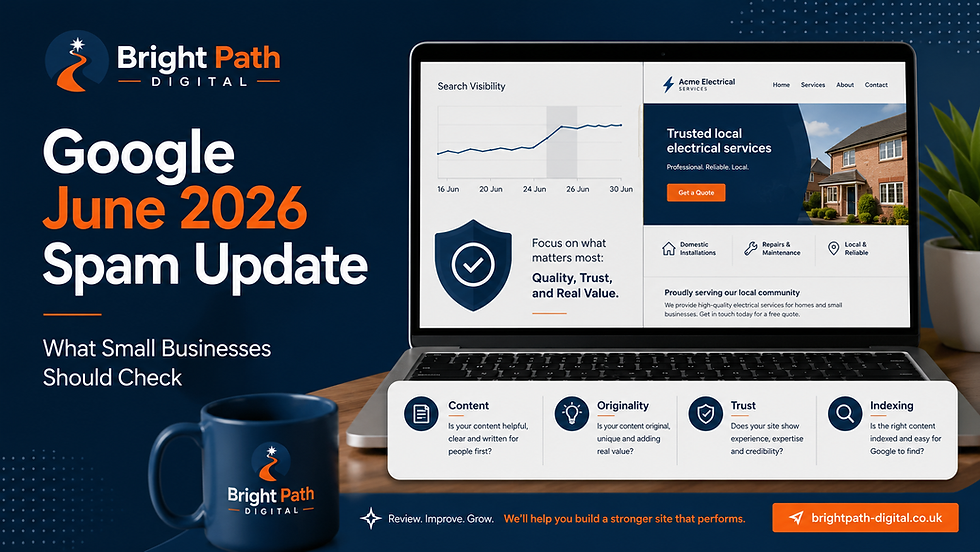
For the separate spam-update guidance, read Google’s June 2026 Spam Update: What Small Businesses Should Check Now.
What appears to matter following the May 2026 update?
Google does not publish a complete list of every system or weighting changed during a core update.
Anyone claiming to know the exact formula is guessing.
However, Google’s own guidance and the patterns observed across affected websites point towards several practical areas worth reviewing.
1. Generic information is becoming less competitive
Many websites publish content that is technically correct but adds very little.
Examples include:
basic “what is” articles that repeat common knowledge
generic lists assembled from other websites
service pages filled with vague marketing wording
location pages where only the town name changes
articles that summarise competitors without adding anything original
AI-generated drafts published without meaningful human input
pages targeting questions that the business cannot answer from genuine experience
One post-update case study reported that broad, commodity-style list articles lost impressions while stronger point-of-view content containing first-hand data performed better. That is one website’s experience, not proof of a universal ranking factor, but it supports Google’s long-standing emphasis on originality and additional value.
For a small business, original value does not require expensive research.
It could be:
a real customer question
an example from a completed project
photographs of genuine work
an explanation of your process
local knowledge
realistic pricing considerations
a mistake you regularly help customers avoid
an honest limitation
a comparison based on direct experience
a practical checklist for your type of customer
Changing the wording of information already available elsewhere is not the same as adding value.
2. Experience and trust need to be visible
A business may possess genuine experience but fail to show it on the website.
A page that says “we provide high-quality professional services” gives Google and potential customers very little evidence.
A stronger page may explain:
who provides the service
what experience they have
what the process involves
who the service is suitable for
where the business operates
what is and is not included
what customers commonly ask
what evidence supports the claims
how the customer can make contact
Trust is not created by adding an “expert” label to an author profile.
It comes from accurate information, honest claims, clear business details, genuine reviews, relevant qualifications, real examples and consistent contact information.
Our guide to clear messaging and trust signals for small-business websites explains how these elements support both customer confidence and wider search visibility.
3. Content quality should be assessed page by page
A common mistake after a ranking decline is to make sweeping changes across the entire website.
That is reckless.
Before rewriting anything, identify:
which pages lost impressions
which pages lost clicks
which search queries changed
whether average positions moved slightly or significantly
whether the decline affected mobile, desktop or both
whether it affected web search, images or another search type
whether the change was site-wide or limited to one group of pages
Google specifically recommends comparing pages and queries before and after an update rather than assuming every fluctuation needs drastic action. Small changes in position may not justify rewriting a page that is still performing well.
BrightPath Digital’s Google Search Console guide for small businesses explains the main performance and indexing reports to review.
4. Your website needs a clear purpose
A focused website is easier for customers and search engines to understand.
A roofer does not need to publish general property news every day.
An accountant does not need hundreds of generic business-motivation articles.
A beauty salon does not need automated pages covering every possible health question.
Content should support:
services the business genuinely provides
products it genuinely sells
questions customers genuinely ask
decisions customers need to make
problems the business is qualified to solve
locations the business genuinely serves
Publishing across dozens of unrelated topics does not automatically build authority.
It can make the website look unfocused and create a large collection of pages that receive little attention, updating or quality control.
5. AI-assisted content is not automatically the problem
The May update should not be reduced to “Google is penalising AI content”.
Google does not state that content becomes poor or spammy simply because an AI tool helped produce it.
The risk comes from what is published and why.
AI-assisted content may be useful when a business uses it to organise genuine knowledge, improve structure, simplify wording or turn detailed notes into a first draft.
It becomes risky when it is used to produce large quantities of generic, repetitive, inaccurate or unreviewed content.
Read Is AI-Written Website Content Automatically Considered Spam by Google? for a practical review process.
The important question is not:
Did AI write this?
The better questions are:
Is it accurate?
Is it useful?
Is it original?
Does it reflect the real business?
Has somebody competent reviewed it?
Does it include genuine experience or evidence?
Would it still be worth publishing if Google sent it no traffic?
6. Search is becoming more AI-led
The May core update happened alongside major changes to how Google presents and processes searches.
At Google I/O on 19 May 2026, Google announced further AI-powered Search features, including more advanced model capabilities, agent-style functions and a redesigned AI-powered search experience.
This does not mean traditional SEO has stopped mattering.
It means websites increasingly need to provide information that can be clearly understood, trusted and used across different search experiences.
Strong foundations still matter:
clear page topics
crawlable content
accurate business information
descriptive headings
useful internal links
structured information
original evidence
appropriate images
clear authorship
reliable sources
a good customer experience
Trying to find an isolated “AI Search trick” is usually a distraction from fixing weak website foundations.
How to check whether your website was affected
Do not diagnose an update by searching your favourite keyword once.
Search results vary by location, device, search history and intent.
Use evidence.
1. Confirm the dates
The May 2026 core update ran from 21 May until 2 June 2026.
Do not compare one random day during the rollout with another random day. Rankings can move throughout an update.
2. Open Google Search Console
Use the Performance report and review:
total clicks
total impressions
average click-through rate
average position
Google recommends waiting until an update has completed and then comparing a suitable post-update period with a period before the rollout began.
3. Compare pages
Sort pages by the difference in clicks or impressions.
Look for clusters.
Did the decline mainly affect:
blog articles?
service pages?
location pages?
product pages?
one particular subject?
older pages?
recently published pages?
A broad decline requires a different response from one underperforming article.
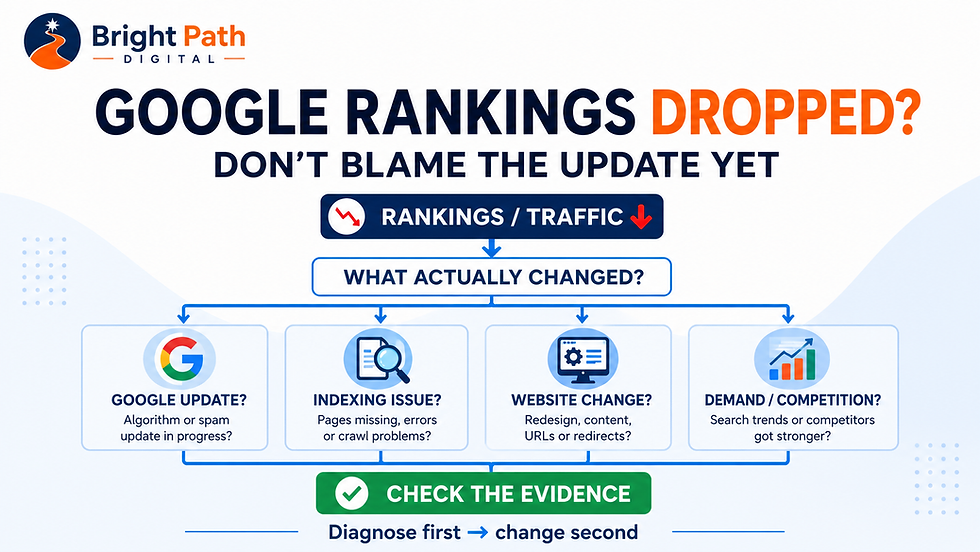
If your rankings, impressions or clicks have fallen and you are not sure whether a Google update is really responsible, follow our guide to what to check when Google rankings drop before making major website changes.
4. Compare queries
Check which searches changed.
A page may have lost visibility for vague informational searches while retaining valuable commercial searches.
That is not necessarily a business loss.
The commercial impact matters more than a headline traffic number.
5. Check website analytics
Search Console shows what happens before a visitor arrives.
Analytics should help show what happens afterwards.
Review whether organic visitors:
viewed service pages
clicked a telephone number
submitted an enquiry form
requested a quotation
booked an appointment
left immediately
returned later
More traffic is not automatically better if the traffic was poorly matched to the business.
6. Rule out other causes
A decline around the update dates may still have another cause.
Check for:
accidentally noindexed pages
indexing problems
broken redirects
deleted pages
changed URLs
website migrations
tracking failures
seasonal demand
declining interest in a service
expired products
major competitor changes
security problems
website downtime
Correlation with an update is not proof of causation.
What not to do after a core update
Avoid:
rewriting every page at once
adding more keywords to every paragraph
deleting content purely because traffic fell
changing URLs without a redirect plan
publishing large numbers of replacement articles
copying pages that currently rank above you
changing dates without updating the content
buying bulk backlinks
creating more near-identical town pages
assuming every decline is a penalty
paying someone who guarantees a recovery
Google advises against quick fixes and says deleting content should normally be a last resort. Improvements should make the website meaningfully better for users rather than simply attempting to reverse an algorithmic change.
A practical seven-point core-update review
Choose each affected page and ask:
1. Does the page clearly answer the searcher’s question?
A visitor should not need to read several paragraphs before understanding the answer.
2. Does it add something original?
Look for real examples, experience, evidence, photographs, data, processes or professional judgement.
3. Is it accurate and current?
Check prices, dates, service details, product information, regulations, contact details and external links.
4. Is the source trustworthy?
Make the business, author, experience and reason for publishing clear.
5. Is the page better than competing results?
Do not judge the page in isolation.
Review the pages now appearing above it. Identify what they explain, demonstrate or organise better.
6. Does the page support a real business objective?
A page should help a relevant customer understand, compare, decide or act.
Traffic without commercial relevance is vanity.
7. Is the next step clear?
Link the article to a relevant service, related guide, enquiry route or practical action.
For the page-level basics, use our SEO settings checklist for small businesses.
How long can recovery take?
There is no guaranteed recovery period.
Google says some improvements may be reflected within days, while broader reassessment can take several months. A website does not always need to wait for the next announced core update, because Google also makes smaller unannounced changes. There is still no guarantee that an improvement will restore the previous ranking.
That is frustrating, but it is also why rushed changes are dangerous.
Measure the problem properly, improve the pages that genuinely need work and monitor the results over time.
Does your business need an SEO audit?
A public-facing SEO audit can identify visible issues such as:
unclear headings
weak service content
missing internal links
poor location wording
thin pages
weak trust signals
confusing navigation
incomplete SEO settings
obvious indexing risks
However, a public audit cannot prove why rankings or traffic changed.
A proper ranking-loss diagnosis requires access to evidence such as Google Search Console and, ideally, website analytics. Anyone claiming to diagnose an algorithmic loss without that data is working from assumptions.
BrightPath Digital’s SEO and Local Visibility Audit is designed to review visible website foundations and local relevance.
Businesses concerned about a specific traffic or ranking decline should first collect their Search Console and analytics evidence before deciding what needs to change.
Final thoughts
The Google May 2026 core update was significant, but it should not trigger blind website changes.
Start with the data.
Identify which pages and searches changed.
Then assess whether those pages are genuinely useful, original, focused, accurate and trustworthy.
For most small businesses, the strongest response will not be more content.
It will be better content, clearer services, stronger evidence, more accurate business information and a website that gives customers a convincing reason to make contact.
The objective is not to chase each Google update.
It is to build a website that deserves to remain useful when Google reassesses the results again.

Comments