What Should an SEO Report Include? A Small Business Guide
Your monthly SEO report arrives.
There is a traffic graph, a list of keywords, several green arrows and a recommendation to keep producing content.
But you still cannot answer:
What changed, what did we pay for, and what should happen next?
That is a reporting problem.
An SEO report does not need to be long or technically impressive. It needs to help you understand whether the work is moving your website towards the outcomes your business needs.
Those outcomes might include more relevant enquiries, bookings, sales or visibility for an important service.
Rankings and traffic help explain the journey. They are not the whole commercial result.
This guide explains what should an SEO report include, which figures deserve attention and what to ask when a report contains plenty of information but very few useful answers.

Quick Answer: What Should an SEO Report Include?
A useful SEO report should show the agreed objective, the reporting period, relevant search performance, changes to important pages, work completed, enquiries or sales where reliably measured, unresolved problems and prioritised next actions.
It should distinguish three things:
Activity: what was done.
Performance: what changed in search visibility and website behaviour.
Business outcomes: whether that activity is associated with worthwhile enquiries or sales.
It should also make uncertainty visible. When tracking is incomplete, results are too early to judge or the cause of a change is unclear, the report should say so.
The test is straightforward:
After reading the report, can you explain what is happening and what you are agreeing to next?
A Weak SEO Report Versus a Useful SEO Report
The problem is not the presence of charts. It is charts without interpretation.
Weak reporting | More useful reporting |
“Visibility improved.” | Identifies which pages and searches changed, over what period, and why those searches matter. |
“You now rank for more keywords.” | Shows whether commercially relevant searches are reaching the appropriate pages. |
“We fixed 30 issues.” | Names the changes, explains their importance and confirms which fixes are live. |
“The website generated 20 conversions.” | Defines the actions counted, their traffic source and whether they became genuine enquiries. |
“Continue creating content.” | Specifies what needs creating or improving, why it deserves investment and who will do it. |
A consistent report layout is helpful because it makes comparisons easier.
Repeated recommendations with no delivery status, learning or explanation are different. That is where you should ask harder questions.
1. The Business Objective and a Meaningful Comparison
The report should begin with what the SEO work is intended to achieve.
“Improve SEO” is too vague.
A clearer objective might be:
Increase relevant enquiries for commercial electrical work within our service area.
That gives the report a basis for deciding which pages, searches and outcomes deserve attention.
It should also state the reporting dates and comparison period. Do not quietly compare a complete month with an unfinished one.
For seasonal businesses, a comparison with the same period last year can add context alongside the previous month. Google’s guidance on investigating search traffic changes explains why changing demand and seasonality can affect performance.
Small numbers need particular care. An increase from two enquiries to four is a 100% increase, but it is still only two additional enquiries.
Show the actual numbers, not just the most impressive percentage.
The report should also note changes that affect comparisons, such as a new booking system, revised tracking or a major website launch.
2. What Happened to Commercially Important Pages?
A whole-site traffic total is a starting point, not a diagnosis.
Suppose visits increased because an old blog post became popular, while the service page you actually want customers to use lost visibility.
“Traffic increased” would be true. It would also be an incomplete account of what matters.
Ask for a short review of priority pages: your main services, products, relevant locations and important supporting guides.
Google Search Console’s Performance report provides clicks, impressions, click-through rate and average position, with breakdowns including pages and queries.
Average position is an aggregate measure, not a guarantee that every customer sees the same ranking.
The explanation should connect the numbers to the page’s job.
For example:
The commercial-cleaning page received more clicks from relevant service searches, while the recruitment article accounted for most of the wider traffic increase.
Those are different developments and deserve different conclusions.
Our Google Search Console monthly checklist explains the underlying checks without treating every movement as a reason to change the website.
3. Which Searches Are Bringing the Right People?
A keyword list needs context.
For an accountant, these searches represent different needs:
“What is bookkeeping?” Someone is learning about the subject.
“Accountant for limited company Runcorn” Someone may be evaluating a provider.
The firm’s name Someone already knows enough about the business to look for it.
All can be useful. They should not be treated as interchangeable evidence of new customer demand.
Ask the report to explain which searches relate to your actual services, whether the appropriate page appears and whether the visitor is likely to be researching, comparing or buying.
Where practical, separate searches associated with your brand from broader discovery searches. State how that distinction was made and acknowledge any limitations.
Do not expect a complete list of every search: Google omits some query data for privacy and other reporting reasons.
Our guide to finding SEO opportunities in Google Search Console explains how to connect a query with the page Google is showing before deciding what to improve.
4. What Work Was Actually Completed?
“On-page optimisation” is not a sufficient explanation of a month’s work.
A useful report should identify the affected page, the change, its purpose and whether it has been implemented.
For example:
Illustrative work-log entry: We updated the commercial-cleaning page to clarify the service area, explain the quotation process and answer two recurring customer questions. The changes are live. Their effect on search performance and enquiries remains under review.
That is more useful than:
Service page optimised.
A simple work log can use:
Page | Change | Reason | Date | Status | Verification
Keep completed work separate from recommendations, drafts awaiting approval and changes waiting for a developer.
This protects both sides. An agency should not claim an unpublished draft as an implemented improvement. Equally, a business should not expect results from work it has not approved or supplied the information needed to complete.
Monitoring and investigation can also be legitimate work. The report should explain what was checked, what was learned and why no change was necessary.
5. Which Technical Problems Matter—and What Is Their Status?
A report should explain significant technical findings without becoming a monthly dump of every warning an SEO tool can produce.
For each important issue, ask:
Which pages are affected? What is the consequence? What evidence supports it? Who is responsible for the next action?
Useful status reporting distinguishes a fix that has been implemented from one whose effect has been verified.
For example, removing an unintended indexing restriction is an implementation step.
Confirming that Google has subsequently indexed the page is a separate observation.
Do not judge technical health solely by the number of URLs excluded from search.
Google’s Page indexing guidance explains that not every URL should be indexed; the reasons and the importance of the affected pages matter.
The same principle applies to repeated warnings. Fifty instances of one template problem may require one coordinated fix, not fifty unrelated tasks.
The useful outcome is a clear explanation of what remains unresolved—not simply a larger “issues fixed” total.
6. Did Search Traffic Produce Meaningful Enquiries or Sales?
This is where a report should connect search performance with commercial reality.
For a lead-generating business, useful measures might include completed quotation requests, bookings and qualified enquiries: enquiries that genuinely fit the services, location and customers the business serves.
For an online shop, orders and revenue may be more directly measurable.
But first establish what the report calls a conversion.
Google Analytics allows important actions to be marked as key events. That makes the choice and configuration of the event important; the label alone does not tell you whether somebody became a customer. Google provides a guide to setting up and verifying a lead-related key event.
A telephone-link click is not proof of a completed conversation.
A contact-page visit is not an enquiry.
A submitted form may be spam, a duplicate or a request outside your service area.
Ask the report to distinguish these stages rather than combining them into one flattering total:
Tracked action → genuine enquiry → qualified enquiry → customer
Our guide to what small businesses should track in Google Analytics explains how website measurements can be considered alongside enquiry and sales records.
Be honest about attribution
The report should say how an enquiry or sale was attributed to organic search.
For example, is it using the visitor’s first recorded source, the source of the relevant session or another attribution method?
Do not quietly label every enquiry received by the business as an SEO result.
Likewise, recorded attribution is not proof that the latest SEO work caused all the attributed business.
Where tracking is incomplete, “we cannot reliably measure this yet” is more useful than invented revenue estimates. The next step should be an agreed measurement improvement, with an owner and a date.
7. Does Local Reporting Distinguish Interactions from Customers?
For a local business, the report may also need to include relevant Google Business Profile activity—not just visits to the website.
However, the definitions matter.
Google’s Business Profile performance documentation defines the Calls metric as clicks on the profile’s call button. It is not a count of answered calls or paying customers. The documentation also notes that performance data can include organic results and Google Ads activity.
Therefore, a report should not automatically present every profile interaction as business generated by organic SEO.
Keep profile interactions, website activity and actual enquiries distinguishable. Where records can be reconciled, avoid counting the same customer repeatedly across different systems.
The objective is to understand the journey—not add every available number together.
8. What Has Not Worked, and What Have We Learned?
An SEO report should include disappointing results.
That might mean a revised page has not improved, additional traffic is irrelevant or a newly published guide is not yet attracting useful visibility.
The explanation should distinguish:
Observed fact: what the data shows.
Possible explanation: what might account for it.
Next investigation or action: what will happen now.
For example:
The service page received more impressions after its revision, but clicks and enquiries have not increased. The new impressions may relate to broader searches. We will review the queries before changing the page again.
That is more credible than claiming the revision succeeded simply because one number increased.
It is also better than declaring failure immediately. Some outcomes take longer to assess, and a monthly comparison does not isolate every influence.
Ask for evidence and a reasoned response—not certainty that the data cannot support.
9. What Happens Next—and What Will Not Be Done?
The report should end with a short, prioritised plan.
Each action should identify the page or issue, the reason for doing it, the responsible person, the target date and what will be checked afterwards.
“Continue SEO” is not a plan.
A more useful recommendation is:
Improve the main service page’s scope and quotation information before commissioning more articles. The business owner will supply the missing details; the writer will revise the page after approval.
It should also be possible to explain why something is being deferred.
Perhaps an established page is performing adequately and does not need a speculative rewrite. Perhaps another blog post would duplicate an existing answer. Perhaps the priority is fixing enquiry tracking before making stronger claims about lead generation.
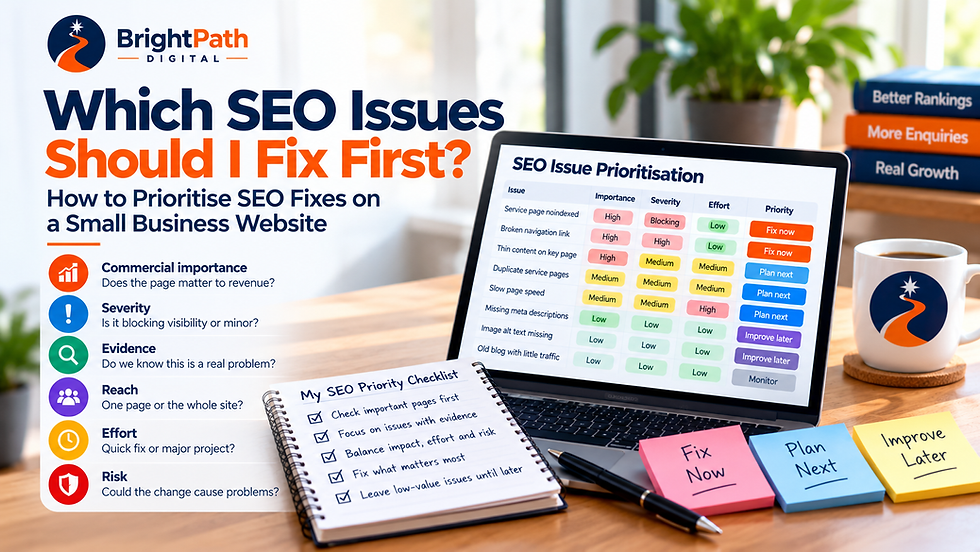
Our guide to which SEO issues to fix first explains how to weigh commercial importance, severity, evidence, reach, effort and change risk.
A useful report should help you choose—not create pressure to approve every possible task.
What Should the Report Say About Data Limitations?
Ask for a short explanation of the data sources and anything that prevents a fair comparison.
Search Console clicks and Google Analytics sessions are different measurements and will not necessarily match. Google explains that configuration, tracking choices, attribution and other differences can affect comparisons between the tools.
You can read Google’s guidance on using Search Console and Google Analytics together.
A useful limitations note might explain that telephone enquiries are not tracked, that form tracking changed during the month or that lead quality has not yet been reconciled with business records.
“Not measured” should not be presented as zero.
And a report should not claim to know exactly which keyword generated each customer unless it can substantiate how that connection was measured.
A Simple Monthly SEO Report Example
The following is fictional and illustrates a reporting format. It is not a BrightPath client result.
Objective: Increase suitable quotation requests for commercial electrical work.
Comparison: The latest complete 28 days against the preceding 28 days.
Measure | Previous period | Current period | Interpretation |
Search Console clicks to priority service pages | 180 | 210 | More search visits reached the pages being prioritised. |
Completed quotation forms attributed to Google organic in Analytics | 6 | 7 | A small increase; too little evidence for a strong conclusion. |
Qualified enquiries matched to those forms in business records | 4 | 4 | No increase in qualified demand has been demonstrated. |
Work completed: Revised one service page and updated relevant internal links. Both changes are live.
What we learned: More search visits have not yet produced more suitable quotation requests. That needs investigation rather than a claim of proven commercial success.
Limitations: Telephone enquiries are not attributed. Results cover a short period, and the effect of individual changes cannot be isolated.
Next action: Review the searches reaching the service page and clarify its scope. The business owner will provide the missing information before the copy is revised.
Not prioritised: Additional general-interest blog posts until the service-page question has been addressed.
That report is useful because it supports a decision—even though it does not present an unqualified success story.
Questions to Ask Your SEO Agency
Use these questions when reviewing the report:
What was implemented this month, on which pages, and what is still pending?
Which commercially important pages improved or declined, and for which searches?
What evidence connects the results with the work, and what remains uncertain or too early to judge?
Did the traffic generate relevant enquiries, and how are those enquiries measured?
What did we learn, and what are you changing, stopping or leaving alone as a result?
What happens next, who is responsible and what do you need from us?
The business also has responsibilities. Your provider may need accurate service information, approvals and feedback about enquiry quality.
A useful reporting conversation makes those dependencies visible rather than allowing each side to assume the other is responsible.
Does a Poor SEO Report Mean the Agency Is Doing Poor Work?
Not necessarily.
Useful work can be explained badly. A polished report can also disguise weak work.
Start by asking for clearer evidence against the agreed scope: completed changes, implementation dates, priority-page performance and the reasoning behind the next recommendations.
A quiet month or an unchanged chart is not enough, by itself, to judge the whole engagement.
Repeatedly vague answers, undocumented work and recommendations that never progress deserve closer scrutiny.
Judge delivery and explanation together.
How Often Should a Small Business Receive an SEO Report?
For an ongoing engagement, a monthly review is a practical starting point. Use longer comparisons where the business is seasonal or the numbers are small.
Urgent problems should be communicated when they are found rather than waiting for the next scheduled report.
The reporting cadence should also match the work purchased. A one-off audit and an ongoing SEO programme are different services.
An audit identifies problems and priorities. Ongoing performance reporting should explain what happened as work progressed.
Our website audit vs SEO audit comparison helps distinguish the scope of different reviews before you commit to more work.
When Would an Independent Website Audit Help?
An audit can be useful when reporting leaves you unsure what the website itself needs.
If the main concern is service content, page structure, local relevance or internal links, BrightPath Digital’s SEO & Local Visibility Audit reviews the public-facing search foundations and identifies priorities.
If the uncertainty also involves messaging, trust, navigation, mobile experience or enquiry routes, the Full Website Audit & Improve Plan provides a broader review.
These are public-facing website audits. They are not substitutes for validating private analytics, checking an agency’s complete delivery history or running an ongoing reporting programme.
Do not buy another audit simply because your existing report is confusing. Ask your provider to explain it first.
Independent review becomes more useful when a clear question about the website remains unanswered.
Final Thought: An SEO Report Should Make the Next Decision Easier
A report has not done its job merely because it contains rankings, charts and a list of completed tasks.
You should finish understanding what was done, which pages and searches changed, whether useful business outcomes followed, what remains uncertain and what deserves attention next.
Do not demand a guaranteed ranking increase every month.
Do demand a clear account of the work and an honest interpretation of the evidence.
The aim is not a report that looks successful. It is a report that helps you decide what is worth doing next.


Comments