Website Audit Case Study: When a 12-Year-Old Website Needed More Than a Few Fixes
A website can remain online for years without obviously being broken.
The telephone number still works.
The email address is correct.
Customers can still see what the business does.
Nothing flashes red to tell the owner:
Your website has fallen behind.
That was essentially the position of one UK builder who contacted BrightPath Digital for a website audit.
The website had been created around 12 years earlier.
From the owner's perspective, the important details had barely changed.
The phone number was the same.
The email address was the same.
The website was still there.
So the perfectly reasonable question was:
Why change it?
The answer only became clear when the website was reviewed from the outside.
This website audit case study shows why an external review can be useful when a business has become so familiar with its own website that gradual problems have become difficult to see.
It also demonstrates something equally important:
a website audit should not automatically end with a recommendation to buy a new website.
The job of the audit is to establish whether the existing site remains a sensible foundation.
In this case, the evidence pointed towards a wider overhaul.

Website Audit Case Study: The Situation at the Start
The business was established.
This was not a startup trying to create its first online presence.
The owner already had a website and had been using it for roughly 12 years.
That creates an interesting problem.
When you look at the same website repeatedly over a long period, it becomes normal.
You know:
where everything is
what each page is supposed to mean
how customers usually contact you
what information has always been there
which parts you simply ignore
A new visitor has none of that context.
They see the website as it exists today.
And their expectations have changed considerably during those 12 years.
The business owner summed up the problem particularly well in BrightPath's public Client Stories:
“You don't notice how much things change until someone shows you.”
That is one of the most useful reasons to audit an established website.
Not because the owner is incapable of seeing obvious problems.
Because familiarity makes gradual change difficult to notice.
You can see the original client story on BrightPath Digital's Client Stories page.
The Problem Was Not Simply “The Website Is Old”
Age alone is a weak reason to replace a website.
A five-year-old website can be poor.
A 12-year-old website can still be useful.
The real question is:
Does the website still support the business and the way customers now make decisions?
That is a different test.
BrightPath's guide to whether you should redesign your website or improve the one you have makes the same distinction.
A website may only need targeted changes when:
its basic structure is still sensible
the platform remains usable
mobile presentation works reasonably well
the services are clear
useful pages already exist
the main weaknesses can be corrected individually
A rebuild becomes more reasonable when the problems are built into the foundations.
So the purpose of this audit was not:
find enough faults to justify selling a new website.
It was:
work out whether the existing website was still the right foundation.
What Did the Website Audit Actually Do?
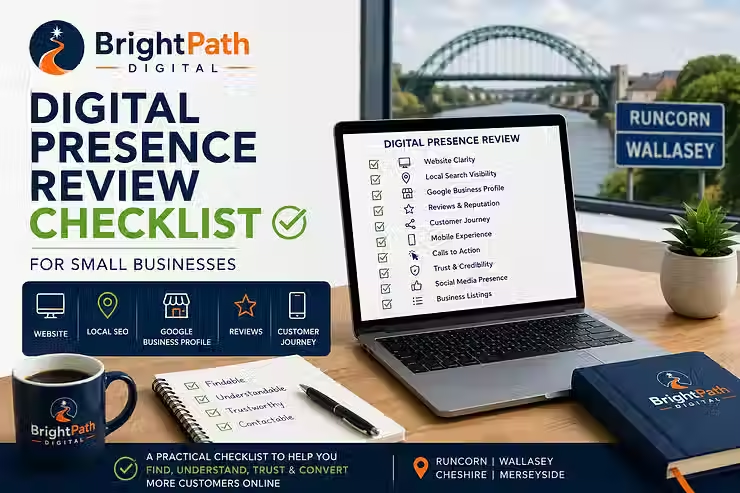
BrightPath's website audits are carried out primarily from the public-facing customer perspective.
That means reviewing what somebody can:
see
read
understand
trust
click
and:
act on
when they encounter the business online.
The live Website Audit & Improve service explains that the review can cover areas including:
website clarity
structure
mobile experience
trust signals
calls to action
enquiry routes
search visibility
page content
customer journey
consistency
The important distinction is that this is not simply an automated website score.
A tool can tell you:
this title is too long
or:
this image is large
or:
this page contains a broken link.
Those checks can be useful.
But they do not necessarily answer:
Does this website still make sense to a customer?
That requires context.
Evidence Matters More Than Personal Preference
It would have been easy to look at an older website and say:
“This looks dated.”
That is not enough.
“Dated” can become a vague design criticism that tells the business owner very little.
A useful audit needs to translate observations into consequences.
For example:
If the structure is unclear
the customer may struggle to identify the relevant service.
If important information is inconsistent
the customer may become less confident.
If the mobile journey is awkward
some visitors may leave before contacting the business.
If proof is weak
the business is asking the customer to trust claims without enough evidence.
If calls to action are unclear
a visitor may understand the service but still not know what to do next.
If the website no longer reflects how the company operates
the site can quietly become a poor representation of an otherwise professional business.
That is why BrightPath's Digital Presence Review guide describes an audit as a prioritised action plan rather than a generic score.
The aim is to establish:
what is working
↓
what is not
↓
why it matters
↓
what should happen next
What the Audit Found
We are deliberately not publishing every line of a client's private audit report.
A case study should demonstrate the process without exposing information the customer did not agree to publish.
What the client has publicly confirmed is that the review highlighted:
where the website was beginning to look dated
areas where it could work harder for the business
improvements that had become necessary
how much online expectations had changed while the owner was busy running the business
The important point is that these issues were not sufficiently obvious to the owner beforehand.
That is normal.
Business owners spend their time running businesses.
They are not necessarily spending every month comparing their website against:
newer competitors
changing mobile expectations
current customer journeys
modern website conventions
improved trust signals
stronger enquiry processes
Gradual change is easy to miss.
The Recommendation Was Bigger Than a Few Cosmetic Fixes
An audit should separate:
quick improvements
from:
fundamental limitations.
Sometimes the outcome should be:
Keep the website and improve these five things.
Sometimes:
Keep the platform but restructure the important pages.
Sometimes:
Rewrite the messaging and improve the enquiry journey.
Sometimes:
Fix the SEO foundations before spending money on a redesign.
And sometimes the evidence shows that repeatedly patching the existing site is no longer the strongest use of the client's money.
That was the conclusion here.
After reviewing the findings, the owner decided that a full site overhaul was the better option.
BrightPath then credited the initial review cost against the redesign work and moved into implementation.
That is a very different process from:
old website → salesperson says “buy a new one” → new website.
The sequence was:
existing website
↓
independent review
↓
evidence
↓
discussion
↓
decision
↓
overhaul
That distinction matters.
Why the Audit Came Before the Redesign
A redesign can easily become an expensive answer to the wrong problem.
Imagine spending money on a completely new website when the existing site only needed:
clearer headings
better calls to action
stronger testimonials
improved service descriptions
updated SEO settings
That would be unnecessary.
Now consider the opposite.
Imagine spending month after month repairing isolated elements of a website when:
the structure is outdated
the customer journey no longer works
mobile usability is poor throughout
maintaining the site is difficult
the business has outgrown what the website was built to support
That can also be poor value.
The audit creates a decision point.
It helps separate:
fixable weaknesses
from:
fundamental limitations.
That is precisely why our improve-or-redesign guide recommends:
review first, then decide.
The Outcome: A Clear Decision, Not a Fabricated Percentage
This is where case studies often become unreliable.
You have probably seen claims such as:
Traffic increased 247%.
Conversions rose 83%.
Revenue tripled.
Sometimes those figures are genuine.
Sometimes they are carefully selected.
Sometimes nobody explains what else changed at the same time.
For this case study, we are not going to invent a performance number simply because case studies are expected to end with one.
The verified outcome at this stage is:
the client understood why the existing website needed more than small patches and commissioned a full overhaul based on the audit findings.
That matters.
Before the review, the position was essentially:
The website still works. Why change it?
After the review:
The weaknesses were clear enough to justify rebuilding properly.
The owner described the review as clear, practical and honest and concluded that the site had reached the point where a refresh was needed.
When reliable post-launch performance evidence exists, that can be measured separately.
Until then, claiming an enquiry or traffic uplift would be speculation.
We would rather publish the part we can prove.
A Website Audit Does Not Have to End in a Rebuild
This case resulted in an overhaul.
That does not mean a website audit is simply a sales process for a redesign.
BrightPath's live Audit & Improve service is deliberately structured around identifying what the website needs, not forcing every client towards the same outcome.
Another site may have perfectly sound foundations.
For example, it could have:
good mobile usability
sensible navigation
useful service pages
some existing Google visibility
a platform the owner can maintain
but still suffer from:
vague homepage wording
weak proof
poor calls to action
inconsistent pricing information
missing service-area information
weak internal links
poor enquiry forms
In that situation, improving the site may be better than replacing it.
That is why the recommendation should come after the diagnosis.
What Should a Real Website Audit Give You?
A good audit should not leave you with 70 warnings and no idea what to do on Monday morning.
It should establish priorities.
At BrightPath, a review can include:
What is already working?
Not everything needs changing.
Preserve useful content, pages and customer routes.
What is creating the biggest risk?
These are the issues most likely to affect clarity, trust, visibility or enquiries.
Which problems are easy to fix?
Some changes may take minutes rather than months.
Which problems require more work?
Structural, technical or content issues may need a planned project.
What should happen first?
Priority matters.
Fixing a minor image-alt-text issue while the main enquiry form is broken is poor prioritisation.
Can the current website reasonably be improved?
This is often the most commercially important question.
The audit should help answer it.
The Owner's View and the Customer's View Are Different
One lesson from this case is particularly useful for established small businesses.
Owners know too much about their own company.
That sounds positive.
For website evaluation, it can be a disadvantage.
You already know:
which services you offer
which areas you cover
what terminology means
which phone number to use
what happens after an enquiry
why customers trust you
how pricing works
which pages matter
The new visitor knows none of that.
Your website has to supply the missing context.
This is one reason websites can look fine while still failing to generate enough enquiries.
The owner experiences the site through years of accumulated knowledge.
The customer experiences it in seconds.
What Would We Check on a Similar Older Website?
Every audit is different, but if a website has been online for many years without a structured review, useful questions include:
Can a new visitor immediately understand the business?
Not:
Does the owner understand it?
A stranger.
Are the main services obvious?
Have new services been squeezed into old pages?
Are discontinued services still visible?
Does it work properly on a normal mobile phone?
Not simply:
Is it technically responsive?
Can a customer actually use it comfortably?
Does the website look active and maintained?
Check:
current services
recent information
working images
current team details
accurate contact information
functioning links
modern browser behaviour
Is there enough trust?
Look for:
reviews
real work
testimonials
client examples
accreditations
named people
useful contact details
current business information
Is the next step obvious?
Can visitors:
call
enquire
book
request a quote
ask a question
without hunting for the route?
Does the site reflect how the business operates now?
Businesses evolve.
Websites often do not.
When Does an Old Website Need Improvement Rather Than Replacement?
Age does not decide.
The foundations do.
Improvement may still be the right answer when:
the structure is basically sound
the platform is supported
mobile usability works
key pages are useful
important URLs already have visibility
individual weaknesses can be corrected without rebuilding everything
In those circumstances, preserve the foundation.
Improve the weaker parts.
BrightPath's guide to managing a small-business website for ongoing growth explains why regular improvement is normally better than waiting years between major interventions.
When Does Rebuilding Become More Sensible?
A rebuild becomes increasingly reasonable when several fundamental issues exist together.
For example:
outdated overall structure
difficult maintenance
widespread mobile problems
poor customer journey
major credibility issues
unsuitable platform
accumulated patches
content architecture that no longer reflects the business
The key word is:
together.
One weak paragraph does not justify a redesign.
One old photograph does not justify a redesign.
One missing meta description certainly does not justify a redesign.
A rebuild should solve a collection of underlying problems that are difficult or inefficient to repair individually.
What Can Other Small Businesses Learn From This Case?
1. “Still working” is a very low standard
A website can technically work and still underperform commercially.
2. Familiarity hides problems
Looking at the same website for years makes gradual deterioration difficult to notice.
3. Do not redesign purely because somebody dislikes the design
Ask what the website is failing to achieve.
4. Do not preserve an old website purely because it already exists
Past investment is not a reason to keep a poor foundation indefinitely.
5. Ask for evidence
If somebody recommends a rebuild, ask which problems genuinely require it.
6. Prioritise customer experience over owner familiarity
The site is primarily for the customer.
7. A review can save money even when it recommends more work
The value is knowing why the investment is justified before spending it.
A 10-Minute Check for an Older Small-Business Website
If your website has been online for several years, open it now.
Preferably on your phone.
Then ask:
Can somebody immediately understand what we do?
Does the website accurately reflect all our current services?
Are discontinued or outdated services still visible?
Is the mobile experience genuinely easy?
Are phone numbers and contact details current?
Are enquiry routes obvious?
Do we show recent proof that the business is active?
Does the design still support credibility?
Can we update the website easily?
Does it represent the business we operate now rather than the business we operated when it was built?
If several answers are uncomfortable, do not immediately buy a new website.
First establish why those issues exist and whether the current site can reasonably be improved.
Frequently Asked Questions
What is a website audit case study?
A website audit case study shows a real example of an existing website being reviewed, the problems or opportunities identified, the recommendation made and what happened afterwards.
The strongest case studies use verifiable evidence rather than invented results.
Does an old website always need redesigning?
No.
Age alone is not enough.
A website should be redesigned when its underlying structure, platform, usability or customer journey is no longer a sensible foundation for the business.
Can a website audit recommend keeping the existing site?
Absolutely.
An audit may identify targeted improvements rather than recommending a rebuild.
That can include clearer messaging, stronger calls to action, trust signals, SEO improvements, service-page changes or mobile refinements.
What did the audit recommend in this case?
The review showed the business owner that the website had become dated and could work harder for the business.
After reviewing the findings, the client decided that a full site overhaul was the right next step.
Did website traffic or enquiries increase?
We are not publishing a performance increase that has not been independently established.
This case study documents the verified audit and decision process.
If reliable before-and-after evidence becomes available, that can be reported separately.
Do you need website-admin access to complete an audit?
Not always.
BrightPath's public-facing audits can review what customers can actually see, understand, trust, click and act on without requiring immediate administrative access.
Additional data such as Search Console or analytics can provide extra evidence where appropriate.
What does BrightPath's website audit include?
Depending on the selected review, BrightPath can examine areas including clarity, structure, mobile experience, visibility, trust signals, content, calls to action and enquiry routes.
You can see the current options on our Website Audit & Improve page.
Final Thought: An Audit Should Help You Make a Decision
The real value of this case was not finding faults.
Anyone can produce a long list of faults.
The value was turning:
“The website still works, so why change it?”
into a clearer question:
“Is this still the right website for the business and its customers?”
In this case, the answer was no.
The evidence justified a wider overhaul.
For another business, the answer may be different.
The existing website may only need five targeted changes.
That is why diagnosis should come before the solution.
If your website has been online for years and you are no longer sure whether it needs improving or replacing, BrightPath Digital's Website Audit & Improve service gives you a practical, plain-English assessment of what is working, what needs attention and what should happen first.
You can also see the original anonymised client feedback alongside other real projects on our Client Stories page.


header.all-comments