Social Media Isn’t Just About Followers Anymore: What Small Businesses Need to Know in 2026
Updated: Sep 2

For years, social media advice for small businesses often came down to the same objective: get more followers.
Build an audience. Grow the page. Encourage people to follow you. Then publish content to those followers.
That still has value—but it is no longer the whole picture.
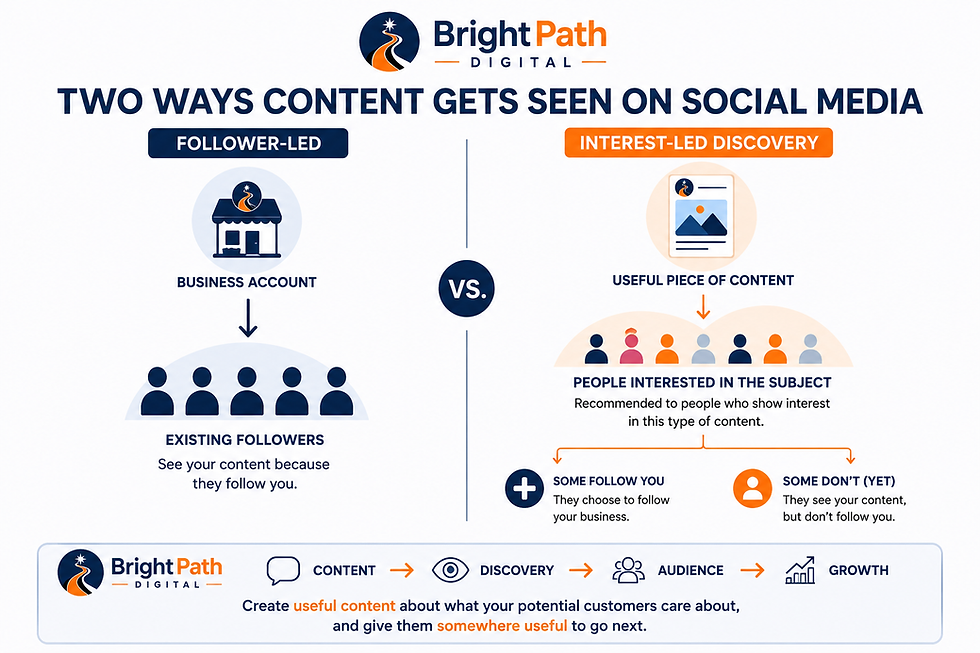
Major social platforms increasingly use recommendation systems to decide which posts, videos and other content individual users are likely to find interesting. That means people can discover businesses and creators they have never followed before.
For a small business with a modest audience, that creates an opportunity.
You do not necessarily need thousands of followers before useful content can reach potential customers.
You need to create something relevant enough to earn their attention—and then make sure there is a sensible next step when it does.
For many small businesses, that journey should look something like this:
Social content → attention → search or website visit → trust → enquiry
Quick Answer: What Has Changed With Social Media?
Social media is becoming less dependent on who someone follows and increasingly influenced by what they appear to be interested in.
TikTok's For You feed is an obvious example. TikTok explains that its recommendation systems consider signals such as what people watch, like, share, comment on and search for when deciding what content may interest them.
Instagram and Facebook also use recommendation systems capable of showing people content from accounts they do not already follow.
Gary Vaynerchuk has described this shift as the move from “social media” to “interest media”: instead of your existing network completely determining what appears in your feed, your current interests increasingly influence what gets recommended.
“Interest media” is a useful way of describing the change, but it does not mean followers are suddenly worthless or that traditional social networking has disappeared.
The important lesson for a small business is simpler:
Your follower count is no longer the only indication of how many people could potentially discover a useful piece of content.
What Does “Interest Media” Actually Mean?
Imagine you run a local landscaping business.
Under a purely follower-led model, a post showing how you transformed a badly drained garden would primarily be distributed to people who had already chosen to follow your page.
Under a recommendation-led model, the platform may also identify that the content could interest people who regularly watch or interact with:
garden transformations
landscaping
drainage problems
home improvements
property renovation
outdoor design
Some of those people may never have heard of your business before.
The same principle could apply to an accountant explaining an upcoming tax issue, an electrician answering a common safety question, a beautician demonstrating a treatment or a consultant explaining a mistake they regularly see clients make.
The opportunity isn't simply to collect followers.
It is to create useful content about subjects that overlap with the interests, questions and problems of your potential customers.
Social Media for Small Businesses: Why This Shift Matters
For a small business, one of the traditional disadvantages of social media was starting from zero.
A large established competitor might have 20,000 followers while a new local business has 200.
It was easy to conclude that the larger account automatically had the advantage.
Recommendation-led feeds weaken that assumption.
They do not remove the advantage of having an established audience, and they certainly do not guarantee that every small account will suddenly achieve huge reach.
But individual pieces of useful content can be discovered beyond an account's existing followers.
That changes the question small businesses should ask.
Instead of:
“How do we get more followers?”
Start with:
“What could we publish that the people we want to reach would genuinely find useful, interesting or worth watching?”
Followers can then become a consequence of useful content rather than the only objective.
Followers Still Matter—But They Are Not the Whole Game
It would be a mistake to swing too far in the opposite direction.
Followers still matter.
Someone choosing to follow your business has shown an interest in hearing from you again. Existing followers can become repeat viewers, advocates, customers and sources of recommendations.
A genuine local audience of 500 relevant people may be far more commercially valuable than 50,000 disconnected followers.
The mistake is treating follower count as the main measure of success.
A social post seen by 20,000 people is not automatically valuable.
For a local business, a post seen by 800 relevant people—including five who visit the website and two who eventually make an enquiry—could be much more useful.
That is why social media for small businesses should ultimately connect attention with a commercial purpose.
Stop Posting About Your Business and Start Posting About Your Customers' Interests
One of the easiest traps small businesses fall into is publishing content that is almost entirely about themselves:
“We're delighted to announce…”
“Another busy week…”
“Don't forget we offer…”
“Contact us for a quote…”
There is nothing inherently wrong with those posts.
But somebody who has never encountered your business before has very little reason to care.
Instead, think about the questions, problems and decisions already occupying your customers.
A plumber could explain:
Why does my boiler pressure keep dropping?
A website designer could answer:
Why is my website getting visitors but no enquiries?
A gardener could show:
What happens when artificial grass is installed without proper drainage?
An accountant could explain:
What records should a new sole trader keep from day one?
A kitchen fitter could show:
Three decisions that make a small kitchen easier to use.
A beauty business could explain:
What should you avoid immediately after a particular treatment?
These subjects start with the customer's interest rather than the business's desire to advertise.
The business still becomes visible—but because it provided something useful.
You Don't Need to Become an Influencer
This distinction matters.
A local electrician does not need to become an internet personality.
A building contractor does not need millions of video views.
An accountant does not need to dance on TikTok.
And a business owner who dislikes appearing on camera does not need to force themselves into producing talking-head videos every day.
Useful content can take many forms:
short videos
photographs of completed work
before-and-after examples
simple graphics
checklists
short written explanations
frequently asked questions
customer stories
demonstrations
comparisons
longer blog articles
The right format depends on your business, audience and available time.
The objective is not to become famous.
It is to become recognisable and useful to the people who may eventually need what you provide.
One Customer Question Can Become Several Pieces of Content
Small businesses often say they do not know what to post.
The problem is usually not a lack of subjects.
It is failing to recognise that ordinary customer conversations already contain the subjects.
Suppose a prospective customer asks:
“Do I actually need a website, or can I just use Facebook?”
That one question could become:
a short Facebook post
a LinkedIn post
a 60-second video
an Instagram carousel
a website FAQ
a detailed blog article
an email to new-business customers
BrightPath already explores that exact question in our guide to whether a new business needs a website or whether social media may be enough.
You do not need seven completely different ideas.
You can take one useful idea and present it appropriately in several places. The platform still needs to suit the business. If your customers are owners, managers, professionals or other business decision-makers, LinkedIn for Small Business in 2026: Is It Worth It? explains when LinkedIn deserves to become a primary channel rather than simply another place to repost content.
Give People Somewhere Useful to Go Next
This is where small businesses can waste the opportunity created by social reach.
Imagine one of your posts performs unusually well.
A potential customer sees it.
What happens next?
They may look at your profile.
They may search your business name on Google.
They may click through to your website.
They may look for reviews.
They may check where you are based.
They may want examples of previous work.
They may want to know roughly what your service involves.
They may simply want reassurance that you are a genuine, credible business before contacting you.
Social media therefore should not be treated as an isolated marketing channel.
Social media creates attention. Your wider digital presence has to do something useful with that attention.
BrightPath's guide to websites versus social media makes the same distinction: social platforms can help a business get noticed, while a website provides somewhere more stable to explain services, demonstrate credibility and make it easy to enquire.
That is why the goal should not simply be:
Social post → more followers
A healthier journey is:
Useful social content → relevant person discovers you → website or search → evidence and trust → enquiry
Don't Send Every Social Visitor to Your Homepage
If someone discovers a post about a specific problem, continue that conversation.
For example:
A landscaping post about drainage could link to a drainage or landscaping service page.
A post answering a pricing question could link to a fuller pricing guide.
A website-design post about poor conversions could link to a guide explaining why websites fail to generate enquiries.
A Google visibility post could link to a practical local SEO guide.
Sending everyone to a generic homepage forces the visitor to start searching again.
Where possible, send them to the page that most naturally answers the question raised by the original post.
The same principle applies to product businesses. If Send-A-Scene publishes a social post featuring a dog or cat, someone interested in that post can be sent directly to its personalised pet gift guide rather than a generic homepage. A birthday-focused post can point to its unique birthday gift ideas instead. The landing page continues the subject that originally caught the visitor’s attention.
Our guide to increasing website traffic explores this in more detail: attracting visitors matters, but attracting the right people and giving them the right next page matters more.
Social Media and Google Search Are Starting to Overlap More
There is another reason this subject matters in 2026.
Social content does not necessarily remain confined to the social platform where it was created.
Google has expanded Search Console with platform properties that can report how eligible content from Instagram, TikTok, X and YouTube is performing across Google Search, Discover and News.
For businesses using those platforms, this creates another opportunity to understand which subjects and pieces of social content are attracting attention beyond the original app.
We explain how the new reporting works in our guide to Google Search Console social media tracking.
This reinforces a broader point.
Customers do not experience your marketing in neat channels.
Someone might:
discover a video → remember the business name → search Google → read a review → visit the website → return two weeks later → make contact.
Trying to attribute the entire customer journey to one follower, one click or one platform can miss what is actually happening.
A Simple 30-Day Social Media Plan for a Small Business

You do not need to transform your marketing operation overnight.
Start with the questions your customers already ask.
Week 1: Find the subjects
Write down ten genuine questions, problems or decisions customers regularly discuss with you.
Do not choose subjects because you think an algorithm will like them.
Choose them because potential customers care about the answers.
Week 2: Create useful content
Take two or three of those subjects and create simple pieces of content.
Try different formats where practical.
One question might become a photograph with an explanation, another a short video and another a written post.
Week 3: Connect the content to your website
Ask what somebody interested in each post should see next.
If you have a relevant service page, guide, case study or FAQ, link to it.
If there is nowhere useful to send them, that may reveal a content gap on your website.
Week 4: Review what happened
Look beyond follower growth.
Consider:
which subjects generated useful engagement
which posts reached people beyond your normal audience
which content led to profile visits
whether website visits increased
which pages people viewed
whether enquiries resulted
which questions or comments appeared repeatedly
Then use those observations to plan the next month.
This test-and-review approach is useful beyond social media. Small Business Marketing Doesn't Need to Be Perfect—It Needs to Be Measured sets out a simple framework for using evidence to decide what to repeat, improve or stop.
What Should Small Businesses Avoid?
The shift towards recommendation-led feeds does not mean you should chase every trend.
Avoid building your entire strategy around viral reach.
A post can generate thousands of views and still contribute nothing commercially.
Be particularly cautious about:
Posting irrelevant trends for reach
If the connection to your actual business is weak, the audience you attract may be equally irrelevant.
Copying competitors
Seeing another business succeed with a particular post does not mean copying it will produce the same result.
Obsessing over frequency
Publishing seven weak posts every week is not automatically better than producing two genuinely useful ones.
Treating every platform identically
The underlying idea can be reused, but presentation should reflect the platform and audience.
The platforms themselves also suit different types of businesses. If you are unsure where to concentrate your effort, read Facebook vs Instagram vs LinkedIn for Small Business for a practical comparison based on your customers, content and commercial goals.
Relying entirely on social platforms
Algorithms, features and reach can change.
Your website, domain, customer database, reputation and direct customer relationships give you a stronger foundation than dependence on one third-party platform.
How Do You Know Whether Your Social Media Is Working?
Start with the business objective.
If you want enquiries, measure signals connected to enquiries.
Useful indicators can include:
relevant website visits
calls
contact-form submissions
quote requests
bookings
profile visits
searches for your business name
useful comments and questions
repeat engagement from potential customers
which subjects consistently attract the right audience
Once you start measuring enquiries, there is a second question: can you tell whether social media actually helped generate them? How Do You Know Which Marketing Channel Generated an Enquiry? explains how to compare social activity with Google, email, advertising, AI and referrals using more than last-click data alone.
Followers and likes can still be useful indicators.
They simply should not become the final objective.
A business with 400 followers and a steady flow of relevant enquiries is in a stronger position than one with 20,000 followers that cannot turn attention into customers.
If that sounds familiar, the next question is where the journey is breaking down. Our guide to Why Your Social Media Gets Likes but No Enquiries looks at what can happen between somebody engaging with a post and eventually becoming a customer — including audience relevance, unclear next steps, the wrong landing page, weak trust signals and unnecessary enquiry friction.
Frequently Asked Questions
Do followers still matter on social media in 2026?
Yes. Followers remain valuable because they represent people who have deliberately chosen to hear more from you. However, recommendation systems mean content can also be discovered by people who do not already follow the account.
What is “interest media”?
Interest media is a term used to describe feeds where content is increasingly recommended according to subjects and behaviours a user appears interested in, rather than being determined purely by accounts they follow.
Can a small social media account still reach lots of people?
Potentially, yes. Recommendation systems can expose individual posts to people outside an account's existing followers. However, large reach is never guaranteed, and commercially relevant reach matters more than simply generating views.
What should a small business post on social media?
Start with genuine customer questions, common problems, useful advice, examples of work, demonstrations, comparisons and explanations of how your service works.
Should social media send people to my website?
When there is a relevant next step, yes. Rather than linking every post to the homepage, direct people towards the service page, guide, case study or enquiry page that naturally continues the subject they were interested in.
Final Thoughts
The changing nature of social media creates a useful opportunity for small businesses.
You do not necessarily need the biggest audience.
You need to understand the people you want to reach, create material that genuinely interests or helps them, and give them a sensible route to take the next step.
Followers still matter.
But they are no longer the only game.
Think beyond:
How many followers do we have?
Start asking:
What are our potential customers interested in, what can we genuinely help them with, and what happens after they discover us?
That is where social media starts becoming part of a wider business system rather than another number to chase.
Social → attention → search or website → trust → enquiry.
If your business is getting attention online but your website is not turning that attention into enquiries, a BrightPath website audit can help identify where customers may be getting lost—from visibility and messaging through to trust signals and enquiry routes.


Comments